
· 23 days ago
SIMD-0411: Double Disinflation Rate by lostintime101
This SIMD proposes updating the inflation schedule by increasing the disinflation rate from -15% to -30%, effectively doubling the pace of inflation decline.
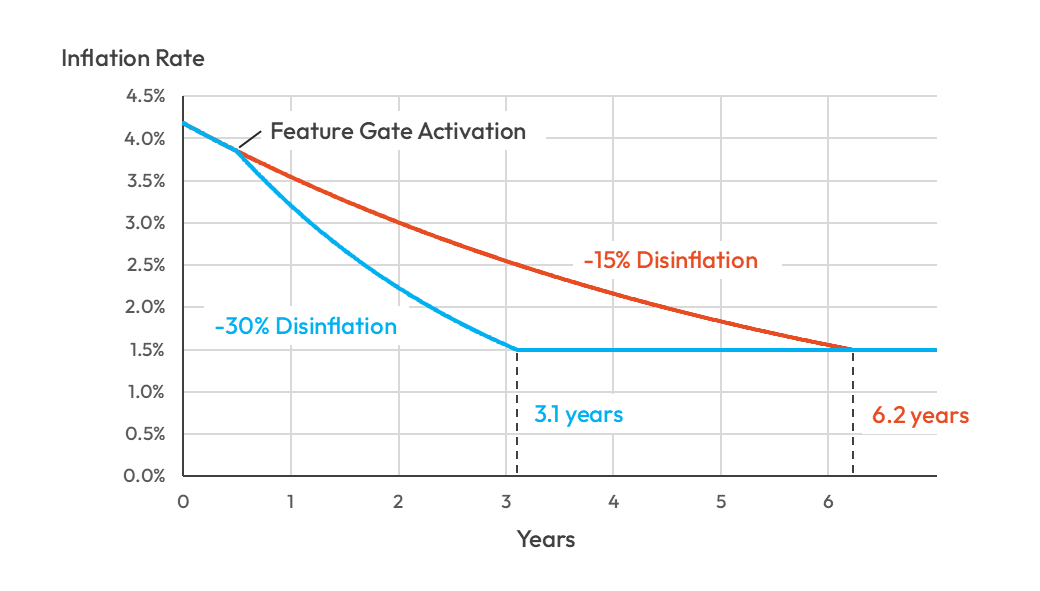
inflation-rate-comparison
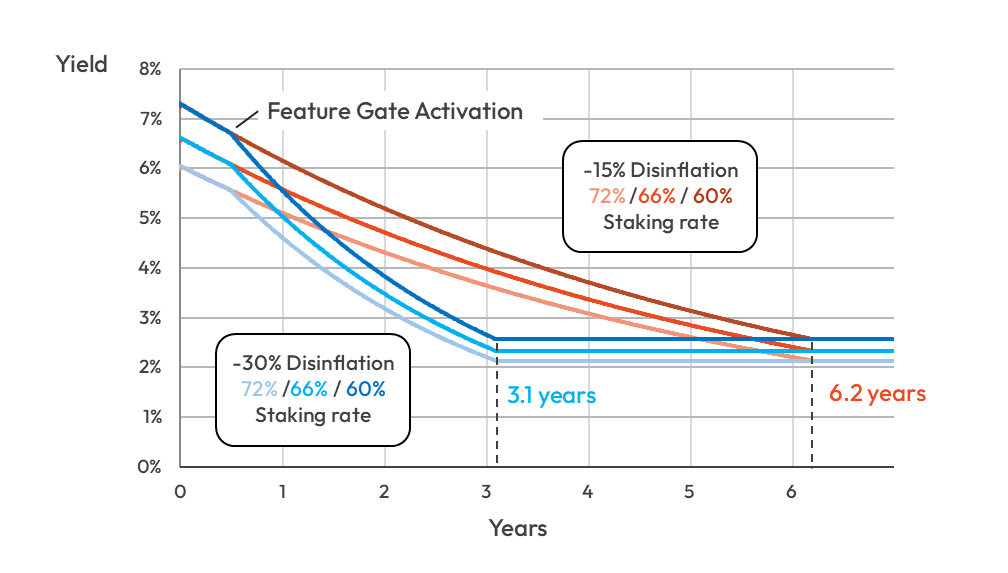
nominal-staking-yield-comparison
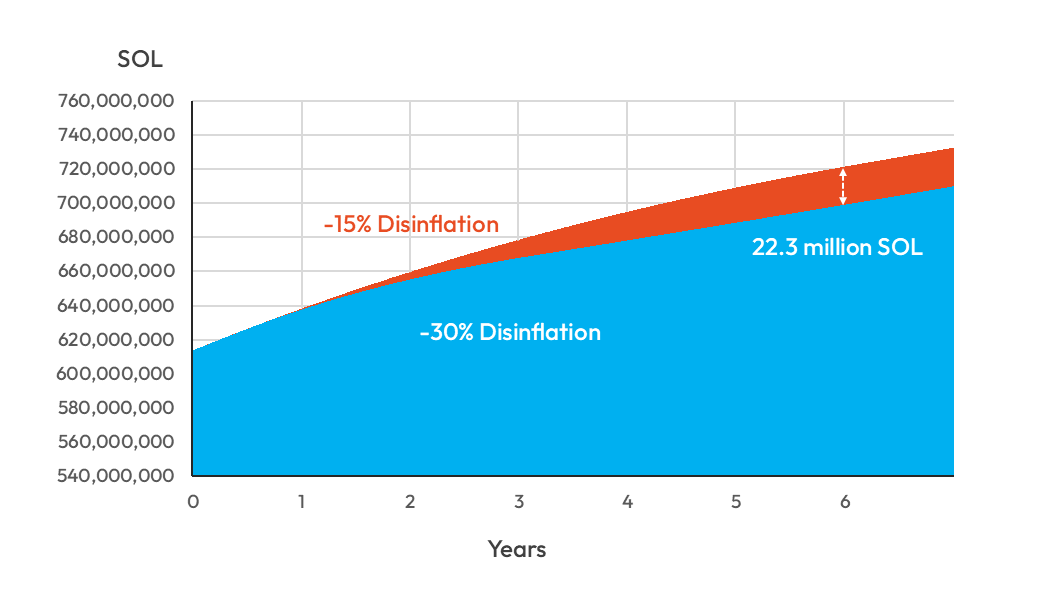
total-supply-growth-comparison
Summary
This SIMD proposes updating the inflation schedule by increasing the disinflation rate from -15% to -30%, effectively doubling the pace of inflation decline.
Our modeling indicates this will have the following effects:
- Reach the terminal inflation rate of 1.5% in 3.1 years (early 2029) instead of 6.2 years (early 2032)
- Reduce emissions by 22.3 million #SOL ($2.9 billion) over six years
- Bring nominal staking yields from the current 6.41% to 5.04% in year one, 3.48% in year two, and 2.42% in year three.
- Have a muted impact on the number of profitable validators, with 10 validators out of 845 transitioning from profitable/breakeven to unprofitable in year one, 27 in year two, and 47 in year three.
Motivation
The core motivation for this proposal is to materially reduce Solana’s emissions schedule. Unlike SIMD-228, doubling the disinflation rate takes a fundamentally different approach to emissions reduction, with the following benefits:
Simplicity: Doubling the disinflation rate requires modifying a single parameter, making it the simplest possible protocol change that delivers a meaningful reduction in inflation. This adjustment will not consume core developer resources. It carries minimal risk of introducing bugs or unforeseen edge cases.
Because the adjustment is intuitive, it can be easily communicated to all stakeholder groups, including retail stakers, non-crypto native institutions, and regulators, regardless of their technical background.
Predictability: Unlike dynamic inflation mechanisms, the effects of doubling the disinflation rate are predictable. This provides strong certainty around future inflation and emissions.
The adjustment gradually reduces emissions over many years, avoiding abrupt shocks to the network or the economic system. The original long-term inflation target (1.5%) remains unchanged; this proposal merely accelerates the path to that established equilibrium.
Supply Reduction: Our modeling indicates that, over the next 6 years, total supply would be approximately 3.2% lower (a reduction of 22.3 million SOL) than under the current inflation schedule. At today’s SOL price, this equates to roughly $2.9 billion in reduced emissions. Excessive emissions create persistent downward price pressure, distorting market signals and hindering fair price comparison.
Plugging the Leaky Bucket: High token inflation increases sell pressure, as some stakers treat staking rewards as ordinary income and need to sell a portion to cover taxes. Max Resnick's analysis outlined a 17% "leaky bucket" tax on inflation (i.e., the gap between ordinary income and the 20% long-term capital gains rate). Combined with governments, centralized exchanges, and custody providers taking significant cuts of staking rewards, even small reductions in issuance can save the network hundreds of millions of dollars per year.
DeFi Usage: High inflation increases the opportunity cost of deploying SOL in DeFi, discouraging participation in lending, trading, and liquidity provision. The effect mirrors traditional finance: higher interest rates raise the risk-free rate and reduce borrowing and spending.
Flexibility: This adjustment does not preclude the community from adopting more sophisticated, dynamic, or market-driven emission systems at a later date.
Why Double?
Any adjustment to the inflation schedule must be significant enough to materially reduce emissions, yet moderate enough to avoid introducing shocks to the system. Doubling the disinflation rate is a straightforward, balanced way to achieve these goals.
The idea itself is not novel, having been independently proposed multiple times (e.g., 1, 2, 3, #modelling-inflation-schedule-modifications">4).
Author lostintime101
Source https://github.com/solana-foundation/solana-improvement-documents/pull/411/files
Repost this post?
Share with your followers.
Reply